
Safe Streets & Roads For All
Planning & Demonstration Projects
Addressing single or multiple Action Plans, pilot programs, evaluations, safety studies, data gathering, and demonstration projects. Econolite is fully prepared to support:
- Carrying out demonstration activities to inform the development of, or an update to, your Action Plan.
- Implementing projects and strategies identified in your Action Plan that address roadway safety problems.
- Performing planning, design, and development activities for projects and strategies identified in your Action Plan.

Support for Supplemental Planning Activities
Follow-Up Data Collection and Safety Analysis
Identify and prioritize roadway risk.
Conducting follow-up data collection and safety analysis to inform the development of new or existing Action Plans, including:
- New collision data analysis to identify updates to the high-injury network.
- Roadway safety-related inventories (such as sidewalk inventories) and road user counts (such as vehicles or pedestrians).
- Post-crash and emergency response data collection to identify opportunities to improve coordinated response, reduce secondary crashes, enhance survivability, and/or improve fatal and serious injury crash outcomes.
Progress Reporting
Leverage data to guide decisions.
Progress reporting on Action Plan implementation for transparency to local stakeholders (e.g., data dashboards, summary reports of projects and strategies implemented/to be implemented) is an eligible supplemental planning activity.
Stakeholder Engagement and Collaboration
Engage communities to build safer roadways.
Stakeholder engagement and collaboration to inform Action Plan development are eligible for supplemental planning activities.
Roadway Safety Planning
Enhance your comprehensive safety strategies.
Other roadway safety planning activities that enhance or inform the development of an Action Plan are eligible for supplemental planning activities.
Support for Demonstration Activities
Manual on Uniform Traffic Control Device (MUTCD) Engineering Studies
View Engineering Studies
Various MUTCD Engineering Studies that further safety applications of the MUTCD, including:
- Evaluating warrants for traffic signal installation
- Evaluating warrants for pedestrian hybrid beacon installations
- Accessible pedestrian signal installation
- Rectangular rapid-flashing beacons for vulnerable road users
- Mid-block crosswalk and signal installations
- Lane-use/reversible lane signals
Behavioral or Operational Activity Pilot Programs
View Pilot Programs
Pilot programs for behavioral or operational activities including:
- Piloting a Safe Routes to School program that incentivizes active travel such as priority signal control for pedestrians and school buses.
- Trials to test how emergency medical services respond to crashes, including 9-1-1 and emergency response coordination, data collection efforts and piloting new emergency vehicle preemption systems:
Demonstrating traffic signal pre-emption, emergency vehicle priority systems, or digital roadway alerting tools to improve safe and timely emergency response to crashes.
Pilot testing computer-aided dispatch (CAD) and interoperability features that allow multiple public safety agencies to view and coordinate crash response resources in real time.
Piloting enhanced coordination between 9-1-1 public safety answering points (PSAPs), EMS, fire services, law enforcement, and trauma system partners to improve roadway crash response and reduce fatal and serious injury outcomes.
Testing improvements to accurate incident location identification and communication between 9-1-1 centers and responding units, including GIS or NG9-1-1 data enhancements used to support timely emergency response.
New Technology Pilot Programs
View Technology Pilots
Pilot programs that demonstrate safety benefits of new technologies, including:
Intelligent Transportation Systems:
- Adaptive signal timing and control
- Signal preemption for emergency vehicles
- Safety warnings for wrong-way driving alerts
- Vehicle-to-infrastructure technology, especially those that use the 5.905 – 5.925 GHz spectrum frequency
- Vehicle-to-infrastructure demonstrations using interoperable vehicle-to-everything (V2X) communications capabilities using 4G LTE cellular V2X (C-V2X) technology in the 5.905 – 5.925 GHz spectrum frequency band to enable safety applications for public fleet vehicles.
- Sensors systems for presence of pedestrians and other VRUs





Immediately Ready to Support Six Safety Solution Packages
Every SS4A project has a safety objective. These six solutions help agencies move from identifying risks to delivering measurable improvements.
Econolite as a partner that can help an agency take an SS4A safety objective all the way from identification through implementation and measurable performance.
Projected outcomes and improvements are based on past FHWA published program results, including ATSPM, Every Day Counts (EDC-4), and Proven Safety Countermeasures (PSC) Initiative, as well as NCHRP Reports, Purdue University Joint Transportation Research Program (JTRP), and Econolite projects.
| # | Safety Need | Econolite Solutions |
|---|---|---|
| 1 | High-crash intersections | Cobalt® + Centracs® + Detection |
| 2 | Proactive monitoring | ATSPM + High-Resolution Data |
| 3 | Vulnerable road users | EPIQ RADAR™ + Signal Systems |
| 4 | Corridor safety | Signal Timing + Coordination |
| 5 | Connected infrastructure | ITS + Communications + Centracs® |
| 6 | Measuring SS4A outcomes | Data → Implementation → Performance |
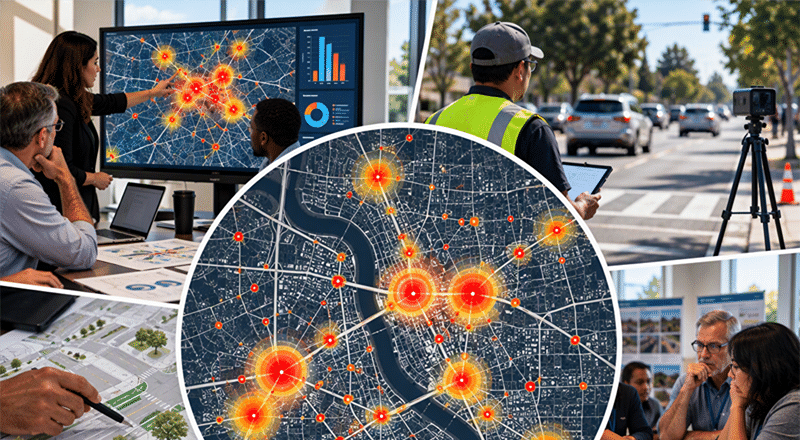




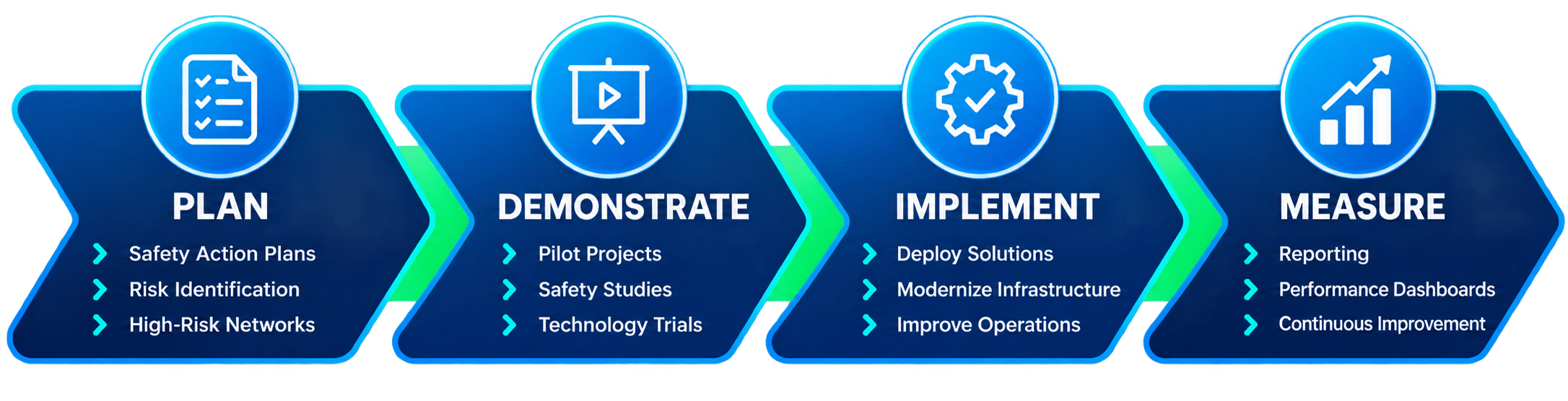
How Econolite Aligns with the SS4A Process




Talk to an SS4A Specialist
Learn how Econolite can support your grant planning and implementation strategy:
SS4A Specialist Support
Connect directly with an Econolite SS4A Specialist for expert guidance on Safety Action Plans, grant application alignment, and high-impact technology deployments.