
Virtual Simulation/Modeling and Validation
Virtual Simulation, Modeling, and Validation in Traffic Management
Virtual traffic simulation and modeling are essential strategic tools for modern infrastructure and traffic management planning. As the integration of emerging technologies accelerates, the visualization and validation capabilities can now be applied in real-time. These technologies create a digital twin, providing a risk-free cyber representation of a physical roadway network for validating traffic analysis, traffic signal optimization, and multimodal planning. Validation ensures accuracy by incorporating actual traffic data, confirming outcomes before implementation. Together, simulation, modeling, and validation support smarter, more sustainable mobility.
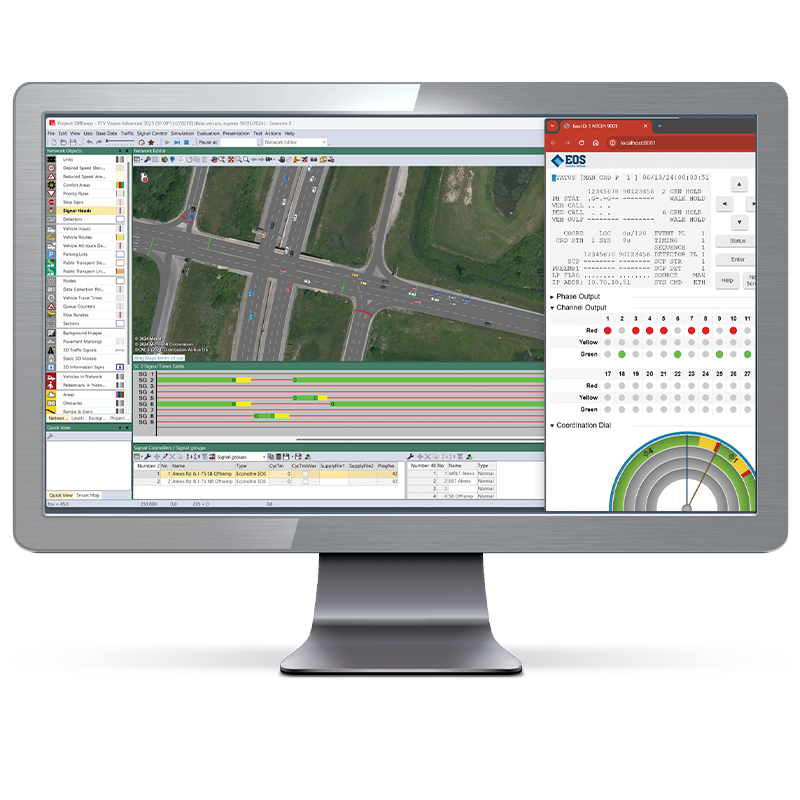
Virtual Traffic Simulation and Modeling for Smarter Mobility
The success of Smart Cities and sustainable mobility will rely more extensively on virtual traffic simulation and virtual traffic modeling. These innovative technologies have emerged as an essential capability in Dynamic Multimodal Network Management. Traffic simulation and modeling empower planners, engineers, and policymakers to visualize, simulate, and validate roadway and traffic scenarios in a cyber or digital twin environment, establishing the foundation for more efficient, accessible, and safer mobility networks.
What Virtual Traffic Simulation and Modeling Is
Defining Traffic Simulation and Traffic Modeling
Traffic simulation and traffic modeling are distinct yet complementary techniques used to replicate and analyze behavioral patterns within transportation systems and physical or digital twin roadways.
Traffic modeling focuses on the theoretical representation of traffic flow, demand, and infrastructure network dynamics. Traffic simulation brings these models to life by animating vehicle movements, signal operations, and multimodal interactions in an active virtual environment.
Traffic ModelingDigital Twin
Simulating Urban Mobility & Supporting Smart City Projects
Leading-edge simulation software tools are essential to accurately modeling traffic and pedestrian patterns. This critical intelligence enables municipalities to anticipate and prepare for the impacts of infrastructure updates, policy shifts, and emerging technologies before physical implementation.
In smart city initiatives, virtual traffic modeling powers data-driven planning and real-time decision-making—helping cities evolve into highly adaptive, resilient transportation environments.
Urban MobilitySmart City Planning
Traffic Management & Multimodal Simulation Applications
Traffic management simulation enables agencies to test signal control strategies, timing plan updates, and adaptive signal control impacts in a safe virtual environment. This approach provides the opportunity to validate performance and quantify improvements prior to field deployment.
Multimodal simulation expands this scope by incorporating vehicles, bicycles, pedestrians, and public transit into a unified digital twin model for balanced, inclusive mobility planning.
Traffic Microsimulation: Delivers granular insights into individual vehicle behaviors, lane changes, and intersection maneuvers—ideal for detailed intersection-level operational analysis.
Dynamic Multimodal Network Management: Integrating these simulation layers helps municipalities visualize smart city transportation ecosystems and explore innovative solutions to modern mobility challenges.
Multimodal SimulationMicrosimulation
Why Virtual Simulation is Critical for Modern Traffic Management
As mobility demands evolve, traditional manual-based traffic planning methods are no longer adequate. Virtual traffic simulation provides a dynamic platform for testing and refining strategies before they are deployed.
Risk-Free Scenario Testing
Virtual or digital twins enable planners to explore many scenarios such as road closures, new transit routes, or changes to roadway capacities without disrupting actual traffic.
This proactive strategy that leverages validation reduces uncertainty and instills more informed, data-driven decision-making.
Digital TwinsScenario Testing
Traffic Signal Simulation and Optimization Before Deployment
Traffic signal simulation enables traffic engineers and urban planners to model signal timing plans according to actual traffic data, optimizing travel times.
By simulating various traffic signal timing scenarios, agencies can reduce congestion and safety risks before physical deployment.
Signal OptimizationPre-Deployment
Evaluation of Multimodal Impacts & Sustainable Mobility Planning
Smart Cities must plan and operate more diverse modes of transportation to make mobility sustainable and accessible. Virtual simulation tools evaluate the interactions between vehicles, transit, and vulnerable roadway users (VRUs), ensuring that the transportation infrastructure benefits all users. This is especially valuable for multimodal traffic simulation, where Dynamic Multimodal Network Management is key.
Leveraging digital twinning supports emissions reduction and green initiatives by quantifying the environmental impacts of traffic strategies. Smart City planners can simulate the effects of mobility mode shifts, traffic volumes, and transit changes.
Multimodal EvaluationEmissions Reduction
From Traffic Modeling to Validation – Ensuring Reliable Outcomes
Successful traffic simulation begins with a robust traffic modeling software solution. However, the true value is realized when modeling and simulation deliver performance-based validation. This process ensures that virtual models and digital twins accurately reflect real-world conditions and reliably generate optimal results for any given scenario.
The Traffic System Validation Process
Calibration involves adjusting model parameters—such as vehicle speeds, driver behavior, and traffic volumes—based on observed roadway data.
Validation confirms that the model replicates actual traffic patterns. By validating solutions virtually, agencies avoid costly field trials and studies while mitigating implementation risks. This step is especially critical for complex mobility ecosystems involving traffic microsimulation, where precision is paramount.
Model CalibrationPerformance Validation
Integrated Tools and Solutions for Simulation & Validation
To achieve high-quality simulation and modeling outcomes, cities, agencies, and engineers rely on integrated software solutions from Econolite and PTV Group.
Proven Expertise and Industry Leadership
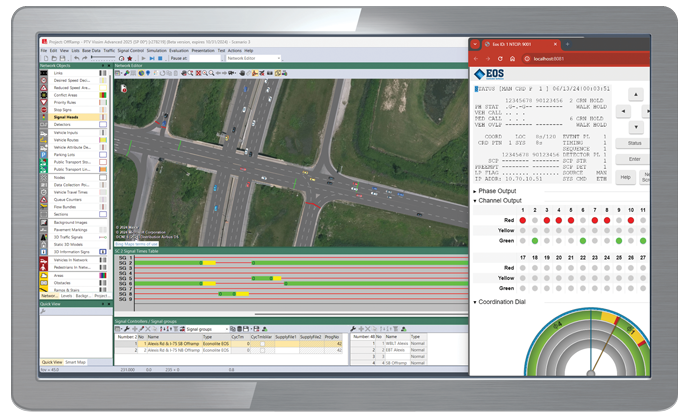
PTV Group offers the world’s leading traffic simulation and modeling software solutions. PTV Vissim digitally reproduces the traffic patterns of all road users on a microscopic scale.
Combined with Econolite’s EOS controller firmware, users can leverage EOS’ dynamic coordinator that can adjust signal timing “on the fly”, powerful in-built safety features that are easy to use, best-in-class support for Signal Control Priority (SCP), and advanced data streaming capabilities. These features can be precisely mapped and verified in PTV Vissim, enabling users to continually evaluate, validate, and optimize the performance of the transportation infrastructure. The integration of Econolite and PTV Group modeling and simulation solutions provide the critical insights for long-term strategic planning and short-term operational use.
Centracs® Mobility – Advanced Traffic Management System (ATMS) Integration
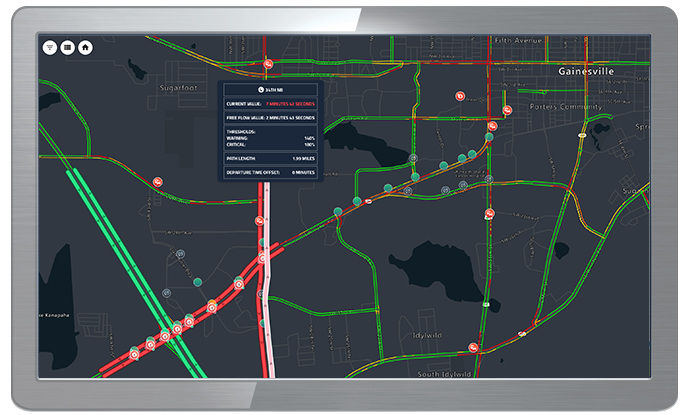
Centracs Mobility is the industry’s leading cloud-based ATMS platform. Integrated with PTV Flows, makes Centracs Mobility the only cloud-based ATMS that enables proactive traffic signal control through AI-driven travel time predictions and optimization. It integrates traffic simulation software with real-time traffic management systems. The integration of Centracs Mobility and PTV Flows enables seamless coordination between virtual models and field operations.
Shaping Smarter Mobility through Simulation
The rapidly evolving mobility ecosystem demands that we adopt smarter, safer, and more sustainable strategies. As a result, digital twining, virtual traffic simulation, and virtual traffic modeling will play increasingly critical roles in Smart City operations and Dynamic Multimodal Network Management. These technologies empower infrastructure stakeholders to make more informed performance-based mobility decisions.
City planners, traffic engineers, and technology providers must adopt and integrate dynamic modeling and simulation as part of Smart City and mobility strategies. Urban planners and transportation agencies must assess current modeling capabilities and identify technology gaps. They also need to explore integrated simulation solutions from Econolite and PTV Group.
It will also be important moving forward to engage with experts and technology partners to continually calibrate and validate your models. By leveraging the power of simulation, digital twins, and virtual environments, we can shape smarter and more sustainable mobility.
0
+ Cabinets
0
+ Traffic Controllers
0
+ Systems Deployed
0
+ Sensors Installed