
Predictive Traffic Management
Predictive Traffic Management Systems: Proactive, AI-Powered Traffic Control
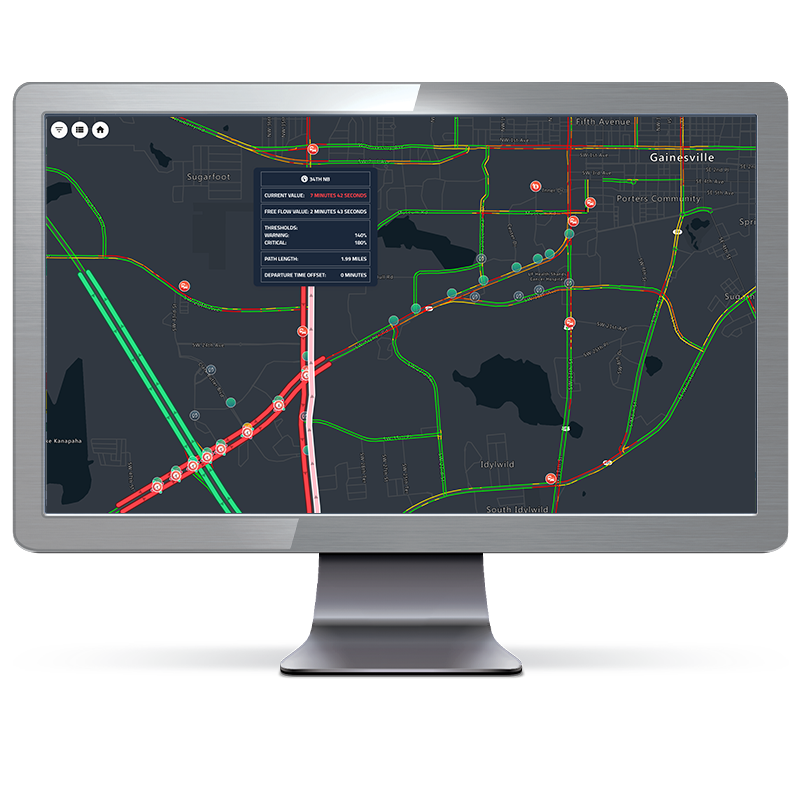
One of the biggest challenges for transportation agencies and traffic management operators has and continues to be improving traffic management efficiencies and operations while preparing for the future. Tomorrow’s traffic management systems will need to dynamically optimize transportation operations for mobility and safety by leveraging big data for traffic prediction. This will require moving from reactive operations to applying predictive traffic control strategies. These predictive capabilities will forecast the dynamic nature of traffic, including changes in patterns, congestion, weather-related incidents, and other roadway variables. This requires a cloud-based predictive traffic management system, such as an Advanced Traffic Management System (ATMS) solution that leverages Artificial Intelligence (AI) and deep machine learning to predict and forecast traffic conditions.
What a Predictive Traffic Management System Is
Predictive vs. reactive traffic control
Traditionally, traffic management has been a reactive function, responding to roadway conditions, incidents, and traffic congestion after they’ve occurred. Dynamically optimizing traffic management makes informed and automated traffic control decisions based on forecasting and predictive capabilities.
Use of AI, machine learning, and big data
Leveraging the synthesis of AI and deep machine learning with real-time and historical traffic data provides situational awareness and predictive travel time analysis. This enables predictive traffic control. By using cutting-edge technologies to make available robust data sources, AI can transform and revolutionize mobility and Smart Cities.
Predictive ATMS Traffic Management System Components
Data Sources
At the heart of any advanced traffic management system lies a collection of data. Sources include GPS signals, traffic cameras, road sensors, weather stations, and historical traffic patterns. These data inputs fuel the engines that power granular tracking and accurate traffic prediction across urban and highway networks.
Analytics Engine
The predictive traffic management system utilizes machine learning algorithms and AI to aggregate, process, and analyze vast volumes of traffic data. The analytics engine identifies emerging patterns, forecasts congestion hotspots, and can feed modelling and simulation programs that can automatically trigger solutions and validate the effectiveness of those solutions.
Control Actions
Predictive traffic control integrates real-time insights into active network responses. Proactive signal control strategies, dynamic routing updates, and incident response coordination are driven by traffic prediction models, enabling the system to automatically trigger applications to mitigate traffic delays and congestion before they happen.
Why We Need Predictive Traffic Management
Challenges with Traditional Traffic Management
Traditional traffic management systems face growing pressure as urban populations increase and annual vehicle miles traveled soar. These systems rely heavily on reactive measures, addressing congestion and incidents only after they occur. This results in delays and risks to safety.
Congestion continues to be a persistent challenge. Without real-time traffic flow prediction, urban areas struggle to maintain mobility. Traffic jams form unpredictably, overwhelming outdated systems that cannot adapt dynamically. Traffic congestion will only get worse, if nothing changes.
Currently, detecting and responding to accidents or road closures often requires manual intervention with very little situational awareness of the roadways and intersections. Without predictive traffic control, emergency responses are delayed, and rerouting solutions are suboptimal. Moreover, traditional systems operate in silos, missing out on the synergy offered by AI-powered traffic management and applications. They fail to integrate data effectively, adding latency to decisions.
To overcome these challenges, cities and transportation agencies must look to adopting intelligent traffic management systems and smart traffic management system architectures that provide predictive and proactive control. These next-generation solutions harness traffic prediction, predictive traffic control, and powerful analytics to anticipate problems before they arise. This creates more efficient, safer, and smarter mobility ecosystems. Predictive traffic management systems transform reactive infrastructure into proactive networks.
Benefits of a Predictive Traffic Control
Proactive Traffic Congestion Mitigation
Proactive traffic congestion mitigation empowers cities to stay ahead of traffic gridlock before it happens. A smart traffic management system integrates predictive traffic control to anticipate congestion patterns using real-time traffic prediction. By analyzing historical and live data, operators can implement adaptive signal timing and route optimization strategies. This minimizes delays and enhances travel times. It also lowers vehicle emissions and improves safety. With intelligent automated alerts to operator dashboards, agencies gain situational awareness and operational agility. Proactive measures driven by predictive AI transforms traffic control into a platform of proactive optimization.
Improving Incident Response
Leveraging predictive traffic control within a robust traffic management system dramatically improves incident response times by enhancing situational awareness and continually optimizing routes for priority vehicles. Through advanced traffic prediction, operators can anticipate high-risk zones and proactively mitigate risks. When accidents occur, predictive analytics provide immediate insights into impact zones, helping reroute traffic and adjust signal timings in real time. This data-driven approach minimizes congestion buildup and supports emergency responders with clearer access routes. By coupling prediction models with intelligent control mechanisms, agencies shift from reactive to anticipatory operations. This enhances road safety and resiliency.
Adapting to Dynamic City Conditions
As cities grow, predictive traffic control becomes more essential. A modern traffic management system powered by predictive analytics in transportation leverages traffic prediction models to anticipate volume surges and congestion. By analyzing real-time and historical data, the system dynamically adjusts signal timings and routing strategies to maintain smooth operation. These proactive adjustments reduce congestion, improve travel times, and support a more reliable mobility. Predictive traffic control transforms traffic signal operations into a more efficient and safer dynamic multimodal network.
Traffic Risk Mitigation
By applying predictive analytics in transportation, agencies can anticipate congestion, accidents, and hazardous conditions before they occur. This proactive approach enables timely interventions, such as signal adjustments or rerouting, significantly improving safety. With accurate traffic prediction, cities can reduce delays, enhance emergency response, and minimize environmental impact. Ultimately, predictive traffic control mitigates risks, protecting lives and optimizing mobility.
How Do Predictive Traffic Management Systems Work?
Predictive traffic management systems leverage cutting-edge, self-learning, self-improving AI model and/or application to continual refine and accurately prediction traffic conditions. As a result, a predictive traffic management system can deliver real-time and predictive traffic analyses, offering up to an hour of forward-looking travel time forecasts across the road network, enhancing proactive decision-making and predictive traffic control.
Data Collection & Prediction Engines
Use of real-time data and historical traffic flow prediction
Predictive traffic management systems rely on historical traffic data alongside continuous real-time streams. By aggregating insights across key sensors, ATMS platforms detect anomalies, automatically adjust signal timings, and reroute traffic before gridlock develops.
GPS & V2X DataRoad SensorsMobile Apps
Traffic prediction using machine learning
Pairing current streams with historical patterns significantly elevates ATMS intelligence. Machine learning algorithms discover subtle correlations traditional systems miss, allowing models to continuously evolve and sharpen forecasting accuracy during commutes, weather events, and special events.
AI AlgorithmsPattern RecognitionProactive Timing
Turning Predictions into Action
Signal retiming, dynamic message signs, and rerouting
Leveraging AI-powered forecasting capabilities allows traffic systems to continually optimize signal timing, update dynamic message signs, and reroute priority vehicles. Predictive algorithms adjust signal phases in milliseconds to promote smooth vehicle progression and push timely updates to guide drivers away from hazards.
Millisecond AdjustmentsPriority ReroutingDMS Driver Alerts
Automated alerts and operator dashboards
Predictive AI enriches TMC dashboards by anticipating congestion and rendering visual map heat zones for instant operator recognition. Automated alerts notify staff of emerging traffic incidents, while customizable dashboards track critical performance metrics such as predicted queue lengths and system health.
TMC Heat ZonesAutomated TriggersQueue Forecasting
System Integration
Econolite’s Centracs® Mobility: Empowering Smarter Mobility with PTV Flows
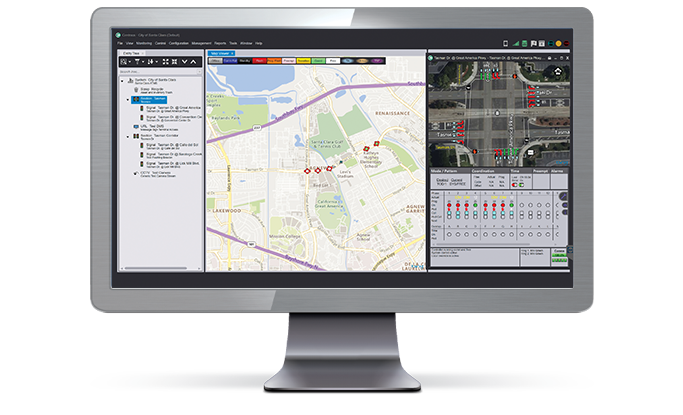
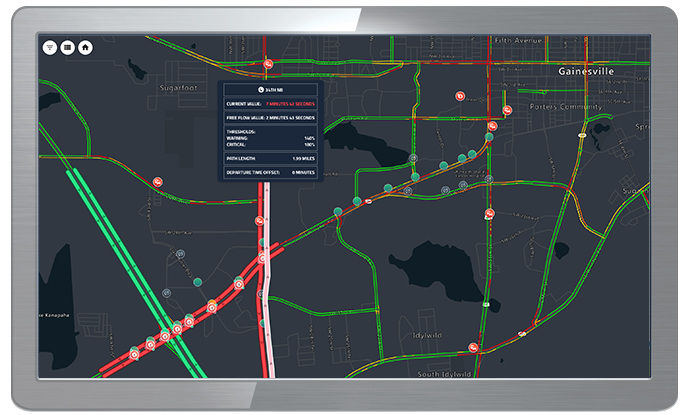
Centracs Mobility with PTV Flows is revolutionizing traffic signal operations by integrating predictive traffic control into modern ATMS infrastructure. As the only ATMS capable of shifting operations from reactive to proactive, this integrated platform combines real-time insights with machine learning to forecast travel times—without requiring additional detection hardware.
No Detection Hardware RequiredProactive ATMS Control
Proactive Congestion Mitigation
Powered by machine learning, Centracs Mobility with PTV Flows analyzes historical trends, real-time conditions, and simulation models to deliver high-accuracy traffic congestion predictions. This enables agencies to proactively address roadway hazards, incidents, and bottleneck congestion before delays occur.
High-Accuracy ForecastingIncident Avoidance
Dynamic Traffic Management in Action
AI-powered algorithms learn from dynamic conditions in real-time to continuously optimize signal timing, corridor performance, and route efficiency while minimizing response lag.
Corridor OptimizationZero Response Lag
Incident Response & Real-Time Optimization
Adaptive machine learning strategies deliver preemptive rerouting and automated alerts—bridging the Vision Zero gap for faster commutes and safer, more sustainable roads.
Vision Zero AlignmentPreemptive Rerouting
Role of PTV Vissim for Simulation & Validation
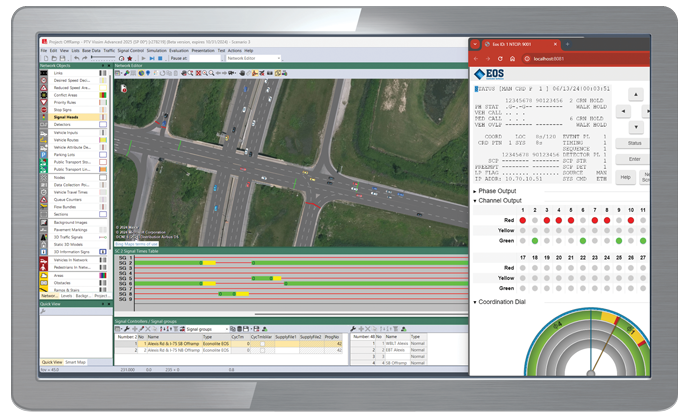
Integrating EOS firmware with PTV Vissim creates a virtual environment for high-fidelity Digital Twin testing—allowing engineers to model and validate signal timing strategies prior to field deployment.
EOS IntegrationDigital Twin Testing
AI Traffic Management & Intelligent Systems
Scalable Smart City ITS solutions combine predictive control with real-time analytics to help agencies make faster decisions, optimize network flow, and reduce vehicle emissions.
Emissions ReductionSmart City ITS
What Are the Benefits of Predictive Traffic Management Systems?
For Cities & Operators
Empowering transportation agencies with proactive operational control.
Reduced congestion and delays
Predictive traffic management systems offer cities a smarter, more proactive approach to reducing congestion and improving mobility. By integrating predictive traffic control into a city’s traffic management system, transportation agencies can anticipate and respond to traffic conditions in real time. These systems use predictive analytics in transportation to analyze historical and real-time traffic data. This enables accurate traffic prediction that can proactively adjust signal timing, routing, and incident response programs.
Proactive decision-making
Implementing a predictive traffic management strategy helps prevent traffic congestion before they form. This reduces travel delays and enhances safety for all roadway users. In addition, predictive systems empower decision-makers with actionable insights for building more accessible mobility and sustainable Smart Cities.
For Safety and Environment
Proactive countermeasures for safer roadways and cleaner communities.
Risk mitigation applications
Predictive traffic management systems play a vital role in enhancing urban safety and environmental sustainability. By integrating predictive traffic control into a city’s traffic management system, agencies can proactively deploy safety countermeasures before incidents occur. Using predictive analytics in transportation, these systems analyze vast datasets to identify high-risk areas, enabling proactive strategies that reduce accidents and improve roadway safety.
Reduced emissions and improved public satisfaction
Another benefit is enhancing travel times while addressing traffic congestion before it occurs. Smoother traffic flow leads to lower vehicle emissions, contributing to cleaner air and healthier communities. These intelligent systems not only support traffic risk mitigation but also enhance traveler experiences by reducing delays. As cities strive for smarter mobility solutions, predictive traffic management will help optimize the future of mobility.
AI-Powered Optimization and Risk Mitigation
How AI Enhances Optimization
Continuous machine learning and adaptive signal intelligence.
Reinforcement learning, pattern recognition
AI-powered traffic management systems continually learn and recognize traffic patterns to optimize signal control. These intelligent traffic management systems use machine learning in traffic management to analyze vast amounts of real-time and historical traffic data, enabling accurate traffic prediction using machine learning.
Adaptive yet predictive signal control
A predictive traffic management system powered by AI enhances proactive traffic control by continuously learning and adapting to changing traffic patterns. This leads to more efficient traffic congestion forecasting and better travel time predictions, enabling proactive interventions that minimize congestion. Ultimately, an AI-powered predictive traffic management system enables cities to make informed decisions and trigger automated countermeasure applications.
Risk Mitigation
Predictive crash analytics and real-time automated safety responses.
Predictive crash analysis
AI is transforming predictive traffic management systems by enhancing safety through the implementation and adoption of advanced crash analysis applications. Using predictive traffic control, AI-powered systems can analyze patterns from historical and real-time data to forecast potential roadway and roadway user conflicts and trigger automated safety responses, reducing crash likelihood and severity. This proactive approach not only enhances roadway safety but also builds public trust in transportation systems and planning. As part of a smart traffic management system, AI-driven crash prediction and safety automation represent a major leap forward in protecting lives.
Red-light running detection and dynamic countermeasures
AI is central to an intelligent traffic management system, where it can power predictive safety applications. Continuously learning from traffic behaviors to improve accuracy and responsiveness, deep machine learning can help applications target predictive interventions and safety countermeasures. AI enables real-time traffic proactive risk assessment and mitigation by automatically identifying high-risk issues. This means a predictive traffic management system can dynamically address red-light running, dilemma zone protection, VRU conflicts, and weather-related hazards by automatically triggering countermeasures such as extended red-light phases or dynamic warning signals.
Predictive Countermeasure Applications
Common Predictive Actions
Automated signal adjustments and real-time traveler guidance.
Proactive Signal Timing Adjustments
By deploying an AI-powered ATMS, cities and transportation agencies can make proactive, real-time adjustments based on live traffic conditions and historical trends. Intelligent traffic management systems leverage AI to use traffic prediction models to anticipate congestion and incidents before they occur. Through predictive traffic control, an AI-powered ATMS can dynamically adjust traffic signal phases and cycle lengths to optimize traffic flows. This level of automation and forecasting enables more responsive and efficient traffic operations, especially during peak travel hours or non-reoccurring events. As part of a smart traffic management system, AI-driven signal optimization not only reduces travel time and emissions but also enhances Dynamic Multimodal Network Management.
Dynamic Rerouting and Traveler Information
AI-powered traffic management systems can enable dynamic re-routing based on current and forecasted conditions. These intelligent traffic management systems analyze live traffic data, incidents, and patterns to identify potential delays and automatically suggest alternate routes to reduce congestion and enhance safety. Through predictive traffic control, AI-powered systems can also push timely traveler information such as detours, estimated travel times, and safety alerts via connected infrastructure and mobile platforms. This proactive communication empowers drivers to make informed and safer travel decisions.
Infrastructure and Resource Strategies
Predictive ramp control, emergency routing, and demand management.
Predictive Ramp Metering and Speed Control
AI is enabling smarter, more responsive control strategies like predictive ramp metering and dynamic speed control. These systems integrate AI into the broader traffic management system, using real-time data and predictive analytics to better anticipate freeway congestion. Through traffic volume prediction, AI models forecast demand surges and congestion, enabling proactive adjustments to ramp metering rates and speed limits. This level of predictive traffic control helps smooth merging patterns, reduce stop-and-go conditions, and maintain consistent speeds across corridors. An AI traffic management approach also supports traffic congestion prediction, enabling agencies to deploy countermeasures before delays escalate.
Resource Deployment (Emergency & Service Vehicles)
By integrating predictive capabilities into a city or municipality’s traffic management system, transportation agencies can dynamically optimize routes for emergency and priority vehicles. Using traffic prediction and traffic flow prediction, these systems identify potential congestion points and proactively adjust signal timing to create clear paths for ambulances, fire trucks, and transit vehicles. Through predictive traffic control, AI enables real-time prioritization of emergency and high-priority vehicles. These capabilities are central to AI-powered traffic management, where machine learning continuously refines predictions and control strategies based on evolving traffic patterns. As part of an intelligent traffic management system, AI-driven emergency response coordination enhances public safety, operational efficiency, and overall system resilience.
Public Notification and Demand Management
AI-powered traffic management systems can analyze real-time and historical data to deliver accurate traffic prediction using machine learning. This enables agencies to proactively push notifications to travelers of upcoming congestion, incidents, or delays through dynamic signage, mobile apps, and V2X systems. Using predictive analytics in transportation, cities can forecast demand surges and implement strategies like staggered routing or alternate travel modes. Through predictive traffic control and traffic congestion prediction, AI systems help reduce peak-hour congestion and improve overall network efficiency.
Real-World Examples and Industry Adoption
Centracs® Mobility and PTV Flows
Centracs Mobility integrated with PTV Flows showcase the power of the only ATMS available that leverages AI-based traffic management in delivering smarter, more proactive mobility management. This integration enables cities like (XX) to harness traffic prediction and forecasting, using machine learning to simulate and optimize traffic operations in real-time.
By combining real-time and historical traffic data with predictive analytics, our customers can proactively manage congestion, visualize traffic scenarios, and validate outcomes before implementation.
Travel Time Forecasting & Alerting: Centracs Mobility with PTV Flows delivers accurate travel time forecasts and real-time alerting solutions at (XX). By leveraging traffic prediction using machine learning, this solution enables customers to anticipate congestion, delays, and incidents before they occur.
It provides a highly scalable and robust predictive ATMS solution for smarter, safer, and more inclusive mobility.
Predictive AnalyticsProactive ATMS
PTV Vissim Simulation and Econolite’s EOS
PTV Vissim integrated with Econolite EOS provides the power of simulation-driven optimization in an AI-based traffic management system with the full capabilities and features of the next-generation EOS controller firmware. This combination enables high-fidelity testing and verification of signal timing strategies in both a digital twin and physical roadway environments. By leveraging traffic prediction using machine learning, customers can simulate various traffic scenarios and assess how signal changes impact traffic flow and safety. The result is a more proactive and smart traffic management system that optimizes dynamic multimodal network efficiency and safety.
Through AI-powered traffic management, our customers can test and refine strategies for traffic risk mitigation, ensuring their infrastructure investments deliver measurable improvements in mobility, reliability, and public satisfaction.
Digital Twin TestingEOS Integration
Contact Us
For a demo or consultation on implementing predictive traffic control through Centracs Mobility and PTV Flows, contact us by filling out the following form:
0
+ Cabinets
0
+ Traffic Controllers
0
+ Systems Deployed
0
+ Sensors Installed