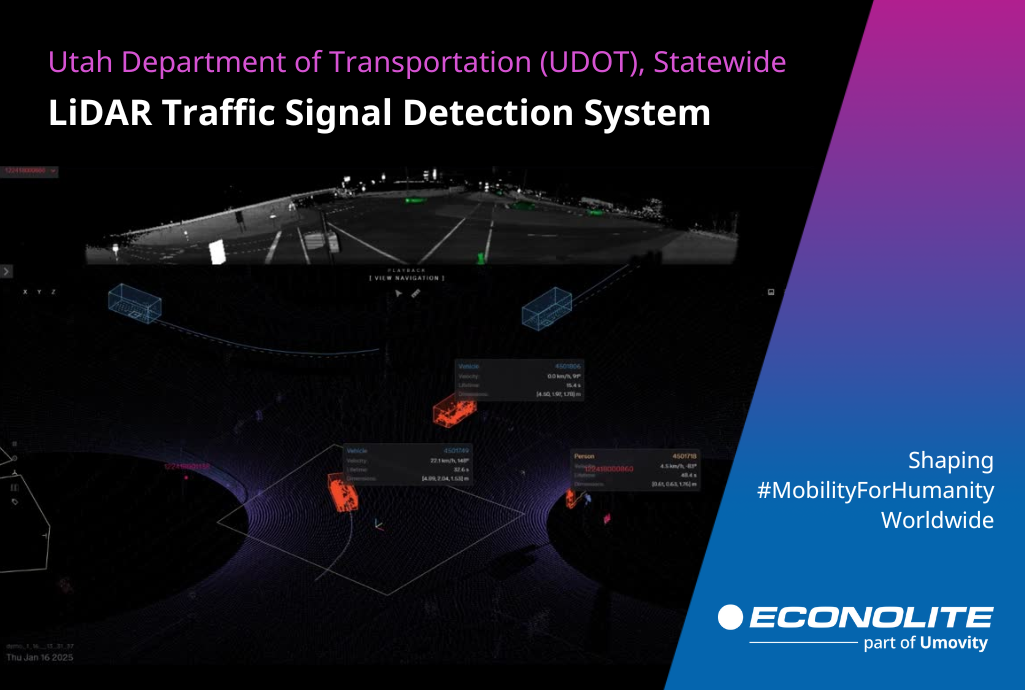
The Utah Department of Transportation’s (UDOT) statewide lidar traffic signal detection system project is a key part of a larger national initiative. Specifically, this deployment supports the Federal Highway Administration (FHWA) Saving Lives with Connectivity: Accelerating V2X Deployment program. In addition, this program represents a broader effort to improve roadway safety, support future connected vehicle programs, and modernize traffic signal operations across Utah. To meet these goals, UDOT selected a next-generation technology that offers high precision under all conditions.
Before selecting a partner, a UDOT technical committee conducted an integrated system performance evaluation of six different lidar solutions. This detailed evaluation scored company experience, customer support, and product warranties. Consequently, Econolite received the highest overall vendor score. Therefore, in 2025, UDOT contracted with Econolite to deploy the lidar traffic signal detection system. To deliver on this program, Econolite partnered with Ouster, a leading global provider of high-performance lidar sensors.
Project Snapshot
| Agency | Utah Department of Transportation (UDOT) |
| Project Type | Statewide Lidar Traffic Signal Detection and Connected Vehicle (V2X) Integration |
| Scope | Statewide intersection and midblock deployment spanning multiple phases through 2029 |
| Key Technologies | Ouster Lidar Sensors, Gemini Detect Software, Econolite Cobalt Controllers, EOS Firmware, ITS Edge Computing Systems |
Key Project Outcomes
- Upgraded state corridors with a cutting-edge lidar traffic signal detection platform
- Protected Vulnerable Roadway Users (VRUs) like pedestrians and cyclists using highly precise 3D sensing
- Maintained highly reliable traffic detection and situational awareness even in extreme winter weather
- Integrated lidar data with existing traffic signal hardware and connected vehicle Roadside Units (RSUs)
- Expanded the program with an additional $3.8 million order in 2026, bringing the project total to $5.5 million
This project leverages lidar’s precise sensing capabilities to reduce collisions and protect Vulnerable Roadway Users (VRUs) like pedestrians and cyclists, further realizing a smarter, safer, and more sustainable infrastructure.
Project Overview
The primary objective of this project is to enhance safety and operational efficiency at intersections and midblock locations. For instance, the system focuses on improving traffic management and optimizing traffic signal coordination through real-time data collection. By leveraging lidar’s precise sensing capabilities, UDOT can actively reduce collisions and protect Vulnerable Roadway Users (VRUs).
To make this possible, Econolite is delivering Ouster’s advanced lidar system. This package includes their Gemini Detect perception software, which provides real-time insights into traffic flow, road user behaviors, and potential safety risks. Moreover, the system integrates seamlessly with UDOT’s existing traffic signal infrastructure, including Econolite Cobalt traffic signal controllers and EOS firmware.
This effort aligns with broader safety initiatives such as video detection and safety enhancement projects that improve multimodal operations.
Deployment and Installation
First, field crews install the non-invasive lidar sensors on existing signal structures without requiring major roadway excavations. Next, the sensor feeds are connected to edge computing devices running specialized software. Because of this local processing power, the system can instantly translate point-cloud data into actionable traffic decisions. Consequently, these steps allow for dynamic traffic signal interventions that improve safety for vehicles, cyclists, and pedestrians alike.
Furthermore, Econolite ensures that the deployed solution supports UDOT’s traffic signal actuation use case and safety-related applications. For example, the system supports VRU detection and connected vehicle V2X message protocols. This complete solution integrates with UDOT’s connected vehicle Roadside Units (RSUs) and is managed through an ITS Edge software system.
Similar large-scale deployments, such as traffic signal system programs, demonstrate the importance of maintaining and upgrading intersection technology.
Technology Used in This Project
- Traffic Detection Systems
- Traffic Signal Controllers
- Traffic Cabinets & Signal Infrastructure
- Installation & Field Services
Operational Benefits
The contract for lidar traffic signal detection systems provides UDOT with many key advantages. For example, the project delivers:
- High-resolution 3D spatial data that is completely unaffected by snow, rain, glare, or darkness
- Seamless software integration with existing Econolite Cobalt controllers and EOS firmware
- Enhanced protection for pedestrians and cyclists through active Vulnerable Roadway User (VRU) tracking
- A clear pathway to V2X connected vehicle communication using edge computing and RSUs
- A highly scalable, multi-year procurement model to support long-term statewide safety goals
Moreover, these ongoing upgrades support overall regional mobility and safety goals. Advanced systems such as traffic data analytics platforms can further enhance system performance and planning.
Ready to Improve Pedestrian Safety?
Econolite provides advanced pedestrian and traffic solutions to improve accessibility, safety, and mobility. Contact Econolite to learn how your agency can deploy accessible pedestrian signal systems.
Related Case Studies
- Video Detection & Opticom Installations
- Integrated Corridor Management
- Traffic Signal Maintenance Programs
Explore Related Solutions
Econolite’s Traffic Control Solutions
Cabinets | Controllers | Software | Detection | Professional Services
Explore more ITS deployments in our ITS Case Study Library.