
Learn more about Umovity.
  Learn more about Umovity.
Skip to navigation Skip to content
Econolite
  • Products
    • Cabinets
      • ATCC
      • Blue Series
      • NEMA
      • Safetran
      • Battery Backup Systems
      • Additional Components
    • Controllers
      • EOS
      • 2070 Series
      • Cobalt®
      • ATC Controller Modules
    • Sensors
      • EPIQ RADAR™
      • Autoscope® OptiVu
      • Autoscope® Vision
      • Ouster™ Lidar
    • Software
    • Professional Services
      • Integration
      • Signals as a Service
      • Field Services
      • Design & Design Build Services
  • Application Areas
    • Dynamic Transportation Management
      • Advanced Transportation Management Systems
      • Predictive Traffic Management Systems
      • Virtual Simulation / Modeling and Validation
      • Intersection and Corridor-Level KPI Reporting
    • Smart Cities
      • Dynamic Multimodal Network Management
      • Intelligent Signal Control Priority
      • Connected and Automated Vehicles
    • Safe Systems (Vision Zero)
      • Emergency Vehicle Preemption
      • Dilemma Zone Detection
      • Safety Event Reporting and Analysis
      • Data Analysis via Detection
    • Sustainable Infrastructure Solutions
      • Cabinets
      • Battery Back-Up Power Systems
      • ITS Maintenance
    • Managed Services
      • ITS Systems Integration
      • Field Maintenance and Construction
      • Asset Management
      • Signals-as-a-Service
      • Customer Success Management Program
      • Training and Support
  • Support
    • Learning Center
    • Technical Documentation
    • Support Request
    • Case Studies
    • Technical Papers
    • Webinars
  • About
    • Leadership
    • Success Stories
    • Traffic Industry ESG
    • News
      • Press
      • Events
    • Evolving Econolite
    • Contact Us
  • Careers
    • Why Work Here
    • Opportunities
    • Application Process
    • Our Values
    • Our Mission, Our Culture
  • Search
Case Study

Colorado Front Range Regional Traffic Modernization

The Challenge | Evaluation Process | Results | Conclusion

Executive Summary

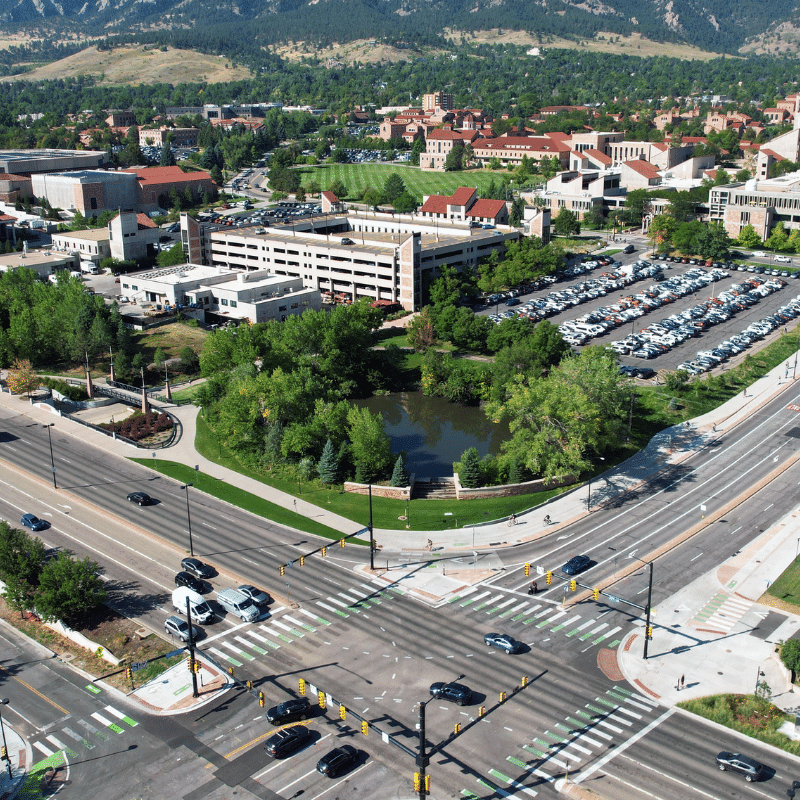
As communities along Colorado’s Front Range continued to experience population growth and evolving mobility requirements, multiple transportation agencies and municipalities sought to modernize their traffic management infrastructure while maximizing existing investments. These jurisdictions, including Colorado Springs, Fort Collins, Centennial, Littleton, Englewood, Arapahoe County, and the South Denver metropolitan area, identified the need for a more coordinated and intelligent approach to improve traffic operations, enhance visibility into transportation networks, and create a foundation for emerging connected and adaptive transportation systems. A key objective was to unify operations across diverse traffic signal control environments while leveraging existing field investments where possible. The goal was to provide a solution that delivered the ability for agencies to better manage and leverage existing multi-vendor traffic signal systems from a centralized platform.
The Challenge

Transportation agencies throughout the region faced a common set of challenges. Traffic volumes varied significantly by corridor, time of day, special events, freight movements, rail activity, and commuter travel patterns. Traditional traffic signal timing plans were often unable to respond effectively to changing traffic conditions, leading to congestion, delays, and reduced operational efficiency. In addition, agencies needed improved visibility into network performance and tools to support data-driven decision-making.

Many jurisdictions operated independent traffic management systems that required extensive upgrades to support emerging Intelligent Transportation System (ITS) applications and connectivity. Agencies sought a solution that would improve signal timing coordination, provide real-time traffic monitoring, support adaptive operations, while establishing a scalable foundation for future connected mobility initiatives without wholesale changes to the existing infrastructure.

The Solution

To address these challenges, agencies selected and deployed Econolite Centracs® Advanced Transportation Management System (ATMS) software as part of a comprehensive modernization strategy. The strategy also on focused on upgrading traffic signal infrastructure and advanced transportation management technologies where needed. Improvements included next-generation Econolite traffic signal controllers, cabinets, as well as leading-edge detection sensors and enhanced communications networks.

A critical component of the modernization effort was support for traffic signal controller and field device interoperability. Rather than limiting operations to basic NTCIP communications, Centracs provided centralized management of both standard NTCIP functionality and advanced vendor-specific controller features across a mixed-controller environment. This enabled agencies to leverage proprietary capabilities, high-resolution data, priority and preemption functionality, adaptive control applications, and advanced traffic management features. By deploying Centracs to help connect and integrate the field devices into connected networks, agencies were able to achieve higher levels of operational consistency and visibility.

In Colorado Springs, approximately 50 intersections were upgraded with advanced controllers, cabinets, school zone flasher systems, and radar detection technology to support next-generation mobility initiatives through is already deployed Centracs system. Littleton and Englewood implemented Centracs, integrating communications, performance monitoring, and CCTV connectivity. Fort Collins deployed real-time travel time monitoring and traffic-responsive signal operations, while agencies in the South Denver metropolitan area implemented adaptive traffic management capabilities that continuously optimize signal timing based on changing traffic conditions. Together, these deployments established an interoperable transportation management framework capable of supporting local transportation priorities, current operational needs, and future smart mobility applications.

Results

The regional modernization initiative with Centracs delivered significant operational benefits across diverse transportation environments and jurisdictions. Agencies gained enhanced visibility into traffic conditions through centralized monitoring and performance management tools while improving their ability to manage mixed-controller networks from a single platform. Real-time traffic data and adaptive control strategies enabled signal timing plans to respond more effectively to changing traffic conditions, reducing congestion during peak periods, special events, freight surges, and unexpected roadway disruptions.

In Fort Collins, Centracs-based traffic responsive operations were used to actively manage congestion along critical corridors, including a two-mile, eight-intersection freight route where adaptive timing strategies helped rapidly clear recurring truck-related backups, mitigate rail crossing queues, and reduce incident-related congestion. In Colorado Springs adaptive traffic management is helping to reduce intersection delays by up to 23 percent, cutting peak-period vehicle delay by an average of 15.4 vehicle-hours. This projects annual travel time savings by about 33,000 vehicle-hours when expanded across larger corridor networks. Safety analyses further projected reductions in severe crashes, including fatal and injury crashes, generating an estimated $28 million in safety benefits and more than $10 million in travel time and vehicle operating cost savings over a 10-year period.

The interoperable architecture also enabled agencies to leverage much of the infrastructure while expanding access to advanced traffic management capabilities, simplifying operations and reducing the complexity often associated with managing multi-vendor environments. As a result, participating agencies improved mobility, strengthened transportation system performance, and created a scalable foundation for future connected vehicle, signal performance measure, and adaptive traffic control applications.

Conclusion

The Colorado Front Range regional traffic operations modernization effort demonstrates how Econolite Centracs and a shared network strategy can transform transportation operations regionally. By integrating real-time data, adaptive traffic management capabilities, performance monitoring, and modern field infrastructure, agencies significantly improved their ability to manage congestion, optimize traffic flow, and respond proactively to changing roadway conditions.

Equally important, the deployment highlights the value of interoperability. Agencies gained centralized access to both standard and advanced controller and field device functionality across multi-vendor environments. This approach preserves existing investments, simplifies management of diverse field devices, and enables agencies to fully leverage the capabilities of their existing infrastructure. The result is a mobility ecosystem that supports adaptive operations, connected infrastructure, emerging mobility applications, and long-term regional growth.


1250 N. TUSTIN AVE.
ANAHEIM, CA 92807
(714) 630-3700

Resources

  • Give Feedback
  • Learning Center
  • Marketing Communications
  • Support Request
  • Technical Documentation

Stay Connected

  • LinkedIn

Legal

  • Trust Center
  • Privacy Policy
  • Proposition 65 Warning
  • Supplier Code of Conduct
  • Terms of Use
COPYRIGHT © 2026 ECONOLITE. ALL RIGHTS RESERVED.
We use cookies on our website to give you the most relevant experience by remembering your preferences and repeat visits. By clicking “Accept All”, you consent to the use of ALL the cookies. However, you may visit "Cookie Settings" to provide a controlled consent.
Cookie SettingsAccept All
Manage consent

Privacy Overview

This website uses cookies to improve your experience while you navigate through the website. Out of these, the cookies that are categorized as necessary are stored on your browser as they are essential for the working of basic functionalities of the website. We also use third-party cookies that help us analyze and understand how you use this website. These cookies will be stored in your browser only with your consent. You also have the option to opt-out of these cookies. But opting out of some of these cookies may affect your browsing experience.
Necessary
Always Enabled
Necessary cookies are absolutely essential for the website to function properly. These cookies ensure basic functionalities and security features of the website, anonymously.
CookieDurationDescription
cookielawinfo-checkbox-analytics11 monthsThis cookie is set by GDPR Cookie Consent plugin. The cookie is used to store the user consent for the cookies in the category "Analytics".
cookielawinfo-checkbox-functional11 monthsThe cookie is set by GDPR cookie consent to record the user consent for the cookies in the category "Functional".
cookielawinfo-checkbox-necessary11 monthsThis cookie is set by GDPR Cookie Consent plugin. The cookies is used to store the user consent for the cookies in the category "Necessary".
cookielawinfo-checkbox-others11 monthsThis cookie is set by GDPR Cookie Consent plugin. The cookie is used to store the user consent for the cookies in the category "Other.
cookielawinfo-checkbox-performance11 monthsThis cookie is set by GDPR Cookie Consent plugin. The cookie is used to store the user consent for the cookies in the category "Performance".
viewed_cookie_policy11 monthsThe cookie is set by the GDPR Cookie Consent plugin and is used to store whether or not user has consented to the use of cookies. It does not store any personal data.
Functional
Functional cookies help to perform certain functionalities like sharing the content of the website on social media platforms, collect feedbacks, and other third-party features.
Performance
Performance cookies are used to understand and analyze the key performance indexes of the website which helps in delivering a better user experience for the visitors.
Analytics
Analytical cookies are used to understand how visitors interact with the website. These cookies help provide information on metrics the number of visitors, bounce rate, traffic source, etc.
Advertisement
Advertisement cookies are used to provide visitors with relevant ads and marketing campaigns. These cookies track visitors across websites and collect information to provide customized ads.
Others
Other uncategorized cookies are those that are being analyzed and have not been classified into a category as yet.
SAVE & ACCEPT