
Case Study
V2X Enabled Interconnected Traffic Control System Innovations, Hawaii DOT
The Challenge | Evaluation Process | Results | Conclusion
Executive Summary
The Hawaii Department of Transportation (HDOT) initiated a project to implement a connected vehicle technology-based solution along 34 intersections of the Ala Moana Boulevard/Nimitz Highway corridor. It is one of the busiest corridors in the state, servicing 50,000+ vehicles daily along its nine-mile span. The connected vehicle technology is designed to reduce congestion, vehicle emissions, and travel time while increasing safety for all roadway users. In addition, the program provides alerts and other traveler information about the corridor to motorists, bicyclists, and pedestrians through a free traveler information app. The connected vehicle program deployment was made possible through a public-private partnership between HDOT, University of Hawaii, and Econolite.
The connected vehicle project is also part of a research project with the University of Hawaii (UH), Mànoa College of Engineering and Econolite to determine and verify the capabilities of the latest connected traffic control systems and cloud-based Signal Performance Measures (SPM) with a real-time adaptive signal control solution to optimize efficiency and safety along the Ala Moana/Nimitz Highway corridor.
The Challenge
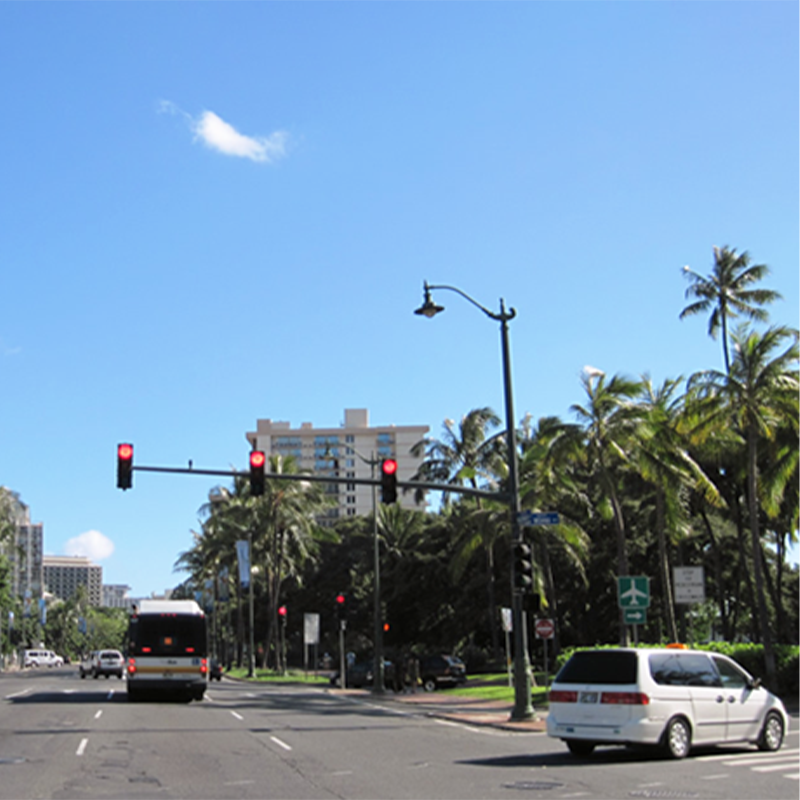
The Ala Moana Boulevard/Nimitz Highway corridor faced longstanding operational challenges that limited mobility and contributed to chronic congestion. As one of Honolulu’s most heavily traveled east–west arterials, the corridor carries a complex mix of commuters, freight traffic, transit vehicles, pedestrians, and cyclists moving between the airport, downtown, and the Waikiki area. This constant demand created recurring bottlenecks, particularly during peak commuter periods, when traffic volumes regularly exceeded the corridor’s ability to move vehicles efficiently. Travel times were often unpredictable, and delays compounded quickly in the absence of tools that could adapt to real‑time conditions.
Traffic signal coordination was a central issue. The corridor’s numerous signalized intersections operated on fixed timing plans that lacked the flexibility to respond dynamically to fluctuations in traffic flow, incidents, or special events. Without adaptive capabilities, signals frequently fell out of progression, resulting in excessive stops, inefficient movement, and increased delay for all modes. The system also lacked real‑time data sharing or communication between infrastructure and road users, limiting situational awareness and preventing proactive management of safety concerns.
These constraints were especially problematic in a multimodal environment where pedestrian activity, turning movements, and transit operations required more responsive signal control. As a result, the corridor struggled to balance mobility, safety, and reliability, underscoring the need for a modernized, data‑driven approach to traffic management.
The Solution
The project’s goal was to push forward a more dynamic and sustainable mobility solution for everybody. Working closely with HDOT, Econolite put forth a rapid deployment schedule that included:
- Centracs® Mobility with SPM and Edaptive
- 34 Cobalt® ATC Controllers
- Established 720 Detection Zones
- Cybersecurity Deployment
- CAV Applications and Integration with a mobile traveler app
Within eight months the secure Centracs Mobility cloud-based ATMS that included SPM, Edaptive signal control was implemented. In addition, V2X solutions, including Cobalt controllers were deployed along the Ala Moana/Nimitz Highway corridor to aggregate and deliver rich traffic data. The technology-based deployment provided a turnkey ITS solution that immediately yielded improvements.
Results
In just a few months, Greenhouse Gas (GHG) emissions and fuel consumption were down 16 percent, and vehicle arrivals-on-green were up almost nine percent. Travel time decreased 50 percent, and vehicle delays decreased by 56 percent. HDOT and University of Hawaii College of Engineering continue to monitor the improvement and results.

Conclusion
The public-private partnership between Econolite, HDOT, and University of Hawaii is a successful example of leveraging cloud-based ATMS, controller, and sensor technologies as a complete mobility ecosystem in helping optimize traffic management and safety. The intention of the public-private partnership is to push this technology forward to ensure the infrastructure is upgraded to address the best interest of the public sooner rather than later. The connected vehicle project represents a proof-point that operationally this kind of interoperable technology solution deployment can have profound positive impacts not only for safer and more efficient travel, but for the environment in the reduction of GHG and fuel consumption.