
Digital Twin & Smart Mobility
Digital Twin Technology to Dynamically Optimize Traffic Signal Operations
The Intelligent Transportation System (ITS) era ushered in the necessary Information Technology (IT)-based traffic management platform. This platform leverages data to make more informed traffic operation decisions. While applications such as adaptive signal control have proven to incrementally reduce travel times and congestion along roadway segments or corridors, the traffic data resolution input and analytical capabilities have been limiting factors in making larger gains.
Today, the availability of high-resolution, real-time traffic data provides the prospect for a real-time cyber representation of a physical roadway network, or Digital Twin (DT). This transportation DT represents a two-way traffic data exchange between the actual roadway and its cyber counterpart, providing a means to model, analyze, and test actual traffic conditions. Moreover, by applying data-driven modeling and machine learning/Artificial Intelligence (AI) algorithms, there is the real potential to develop and effectively apply cooperative awareness and predictive capabilities that will deliver profound benefits to mobility.
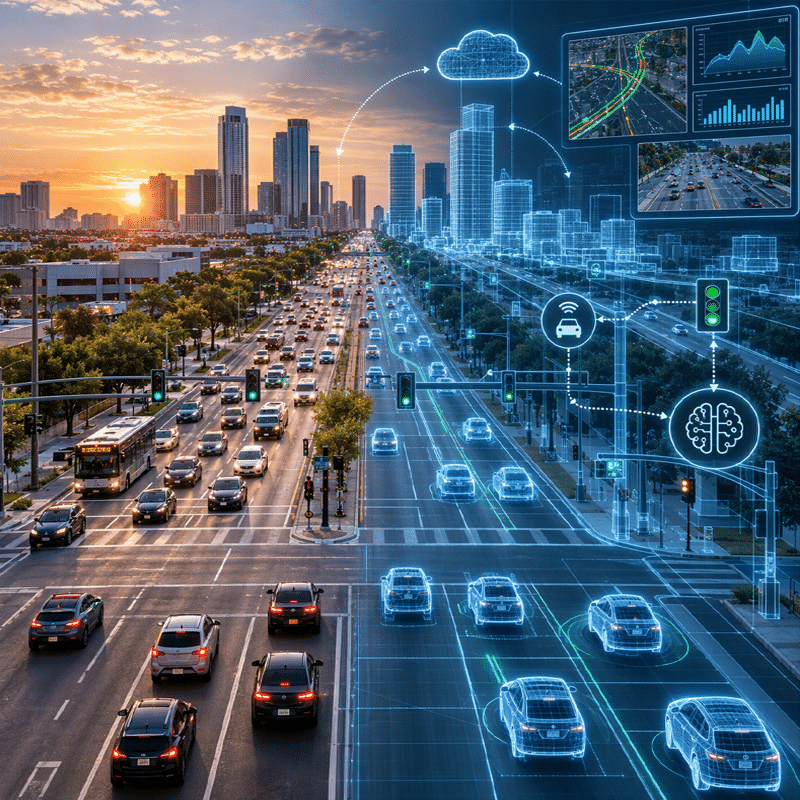
Digital Twin Technology in Traffic Signal Operations
Digital Twin (DT) technology has and continues to be widely adopted and applied to help optimize complex systems and operations in many industries, including enterprise networking, retail, healthcare, structural engineering, manufacturing, and production operations. For transportation, Digital Twins in the Intelligent Transport Systems (Andrey Rudskoy et al.) describes DT as a detailed digital reproduction of the roadway, enabling modeling to test solutions and simulate different scenarios and events.
DT adoption as a strategic capability for surface transportation management has lagged behind other industries because of the lack of data, data resolution, and data taxonomy and management. This is especially true in applications for traffic signal control. Fortunately, there is an established foundation that can help drive the adoption of DT as a traffic management strategy: Signal Performance Measures (SPM) and adaptive signal control applications.
Key Enablers for Traffic Signal Digital Twins:
- 1. High-Resolution & Real-Time Data from Advanced Sensors
- 2. Cloud-Based Analytics & Machine Learning Algorithms
- 3. Foundation of Data-Driven SPM & Adaptive Signal Control
Adaptive signal control and SPM applications that power traffic signal Time-of-Day (TOD) pattern optimization applications have proven to incrementally reduce average wait times and improve corridor travel time reliability by distributing green time, reducing arrivals on red, and traffic queuing at select intersections. However, adaptive signal control is reactive by design. As a result, it continues to be an ongoing challenge to effectively reduce traffic delays throughout an entire transportation network for already congested traffic conditions, including those that are due to planned and unplanned events.
In addition, adaptive signal control has traditionally been applied only to priority corridors. While this helps to reduce travel and average wait times for vehicles at select intersections traveling along a subject corridor where adaptive signal control is applied, it does not necessarily address traffic congestion over the broader citywide network. A significant traffic congestion byproduct is often the adaptive signal control system which can reduce travel and wait times for a corridor, but cumulative average wait times can sometimes increase citywide since the signal timing for adjacent intersections and corridors are not optimized.
To address these limitations, as well as many other future traffic management capability issues, including Connected Vehicle (CV) operations, leveraging a DT strategy that runs a simulation with real-time data integration during system run-time can make revolutionary gains in mobility. This paper examines the potential capabilities that leveraging DT technology for traffic signal operations can provide to a transportation network, as well as its capability for future predictive strategies.
Digital Twin as a Strategy for Traffic Signal Operations
Digital Twin technology has the potential to transform traffic signal management and operations. The concept of creating a DT is to help improve traffic signal operations decision-making by leveraging higher resolution traffic data that is now available. The transportation DT can be conceptualized as traffic data being collected from different sensing and messaging systems, including deployed detection sensors, CV communication systems, personal mobile devices, Closed-Circuit Television (CCTV) cameras, etc. in real time to create an operational cyber copy of the roadway and systems.
Although the concept of DT involves replicating the physical system, it is still a static representation of the roadway on its own. For a transportation DT to be a functional and strategic tool, it must also include a mathematical modeling architecture layer on top to leverage the deployed sensor and messaging systems of the physical roadway, as well as other sources of data to provide real-time movements of all roadway users.
Current Work Towards a Digital Twin Environment
The Virtual Open Innovation Collaborative Environment for Safety, or VOICES, is an example of work being done to establish a digital environment of a physical roadway for traffic signal operations. VOICES is a United States Department of Transportation (USDOT) initiated project that includes a distributed virtual traffic control platform. VOICES enables virtual collaboration among participants in an intellectual property-protected virtual collaborative environment for research and interoperability testing of prototype Cooperative Driving Automation (CDA) management applications.
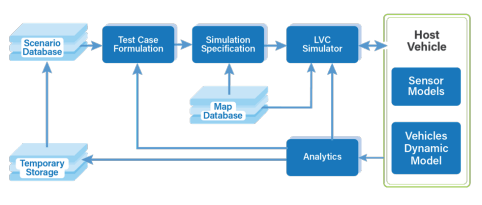
VOICES is designed to provide a digital architecture and platform that provides an effective and efficient traffic management testing environment. The goal of the program, by providing a safe and secure digital platform, helps accelerate the development and deployment of CDA systems. VOICES looks to reduce the development time of data-driven applications that will improve the safety and reliability of CDA systems. The project also provides a trusted simulation, testing, and validation environment for solutions and programming of a complex systems signal system in a virtual digital platform (Figure 1).
Figure 1: VOICES Automated Driving System (ADS) simulation architecture as part of a cyber representation of the physical environment
VOICES allows for different levels of testing, including:
Subsystem Level Testing
Ensures software modules work per design and that data flow between different software modules is functioning properly.
System Level Testing
Verifies system functions against design requirements and validates that the system meets operational needs of stakeholders.
System-to-System Interoperability
Validates correct data exchange with surrounding vehicles, nearby infrastructure, and the Cloud.
VOICES is a traffic scenario-based system that integrates a set toolchain. With expected built-in capabilities—such as emulating and simulating infrastructure; integrating live data from real devices; integrating a set of driving, traffic, and vehicle simulators; and replaying collected real data—complex driving scenarios can be constructed and diversified using VOICES. Generating such a set of driving scenarios enhances system performance to address a larger set of real-world scenarios.
VOICES is capable of hosting and integrating different testing environments to enable system validation under various scenarios. For example, one can connect a real device such as a traffic signal controller to a traffic simulator to virtually control Signal Phase and Timing (SPaT) information at an intersection. In parallel, a set of simulators can simulate pedestrian walk, vehicle motion, and traffic control devices at an intersection. VOICES also allows for blended live, virtual, and constructive testing and validation that links live platforms with manned simulators in virtual environments. A real-time, virtual environment like VOICES is demonstrating the veracity of a real-time cyber representation of a roadway, or DT, as a traffic signal management and operations tool.
Digital Twin presents a new technology paradigm in roadway traffic management simulation. In the past, traffic operation simulations and analytics occurred separately, offline, and used historical traffic data. Digital Twin technology raises the decision-making capability bar to the next level by enabling simulation-based control optimization in near real-time that was technologically unattainable, until now.
It helps establish a technology platform that fosters a systems operational state that can deliver real-time predictive analytics in support of new safety and optimization strategies in traffic management. Macro and microscopic simulation results based on real-time traffic data can provide a foundation for the future real-time analysis and traffic signal operations of comprehensive roadway networks.
Leveraging traffic data aggregated and analyzed for SPM and adaptive signal control applications, along with other forms of CV and mobile data, a DT can accurately model the wait time(s) of approaching vehicles, or further upstream of an intersection or series of intersections. Until now, these capabilities were limited by the traffic data available.
Adopting a Digital Twin Strategy
Next-Generation Sensors Providing the Data
Real-time traffic signal optimization and the efficacy potential of a DT platform is being made possible by new sensor and software technologies, and the high-resolution traffic data they can provide. One of the critical capabilities of new sensor and software technologies are providing is the availability of vehicle classification, trajectory, tracking data, as well as pedestrian and bicyclist data.
Driven recently by the safety applications of CV communication technologies, Vehicle-to-Vehicle (V2V) and Vehicle-to-Infrastructure (V2I) communications, or Vehicle-to-Everything (V2X), high-resolution traffic data represents continuous communication between vehicles, other roadway users, and the infrastructure.
This provides the fundamental physical roadway data to accurately establish a current and future state of the intersection and roadway, or situational awareness, which is essential to the next step in the process of adopting an effective DT strategy.
Traffic Controllers and Firmware
It will be necessary to create a DT of the traffic signal controllers. A critical capability will be a traffic controller firmware that provides virtual interface and control with the DT. The DT of the traffic controllers establishes a current state of vehicles and the roadway network and provides access to the sensor and CV communications data, including object trajectories, classifications, and traffic signal data, including SPaT and MAP (intersection geometry) messages must be transmitted from the traffic controller at the intersections to the corresponding DT.
After the traffic data is communicated from the physical controller to the DT, the process is nearly identical to existing SPM and adaptive signal control applications whereby the data is fed into the adaptive signal control algorithm that generates SPaT parameters, which are then pushed back to the physical traffic signal controller to change signal timing in response to current traffic conditions.
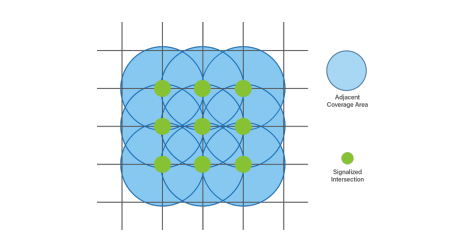
Unlike traditional adaptive signal control applications, the DT provides the capability and platform to simulate the effects of the signal change across an entire roadway network more like a neural network instead of at a few intersections along a single priority corridor. As a result, the DT, leveraging trajectory and tracking detection data, can establish the cumulative average wait time of vehicles approaching an intersection and then the average wait time of the vehicles at intersections citywide. This can only be accomplished through the DT coverage of the larger roadway system, including the network of traffic controllers – not just the immediate intersection(s) along a single or priority corridor. The DT and the traffic data aggregated will need to cover all adjacent intersections as shown (Figures 2a and 2b).
Figure 2a: A simplified diagram of the Digital Twin of the traffic controller network and physical roadway network environment
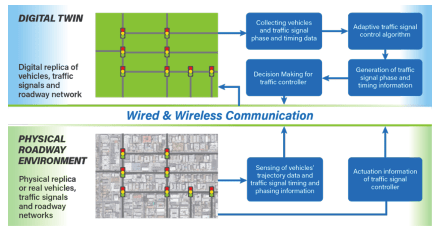
Figure 2b: The Digital Twin of the traffic controller network and the traffic data coverage of adjacent signalized intersections
Green time can then be prioritized at intersections based on the longest average wait time for a given movement, including adjacent intersections, simulated, and then immediately applied. By allocating green time according to distributed average wait times throughout the roadway network can significantly reduce cumulative average wait times.
Moving Toward Predictive Strategies: A Mathematical Model is Key
THE OBJECTIVES OF DT-DRIVEN TRAFFIC SIGNAL CONTROL OPERATIONS:
- Reducing waiting times by dynamically distributing green times
- Responding to real-time traffic demands and allocating SPaT according to cumulative average wait times
- Scaling to a citywide roadway network
- Applying predictive traffic signal control strategies
The primary challenge to leveraging a DT for traffic signal operations will be applying a mathematical model on top of the DT. This modeling architecture will provide the basis for macro and microscopic simulations. However, this requires combining and linking traffic data from diverse and disparate sources of the physical roadway to create a highly accurate cyber copy of the physical roadway traffic operations.
The mathematical model is key to collect and enhance information from real-time data sources to help optimize the traffic signal operations. The model will aggregate real-time data feeds and real-time events, which provide information on the current traffic state on the road, fusing various sources of information into one comprehensive view. This, then allows the model to use a variety of analytical, simulation, and AI tools to deliver measurable traffic and mobility predictions and forecasts (Figure 3).
Figure 3: Sample machine learning architecture for forecasting traffic (diagram courtesy of PTV Group)

In general, predictive analytics applies various techniques including statistical inference, machine learning, data mining, and data taxonomy toward the goal of dynamically and proactively optimizing the signal operations through forecasting, modeling, and understanding future traffic behaviors. This methodology complements well with the architecture put in place through ITS, SPM, and adaptive signal control traffic signal systems based on the aggregation and analytics of historical and real-time traffic data. The data exchange and interface with optimization algorithm structure is already operational.
As with most highly variable operations that require process optimization, it is also advisable to adopt an operational strategy that constantly optimizes the adaptive signal control for a range of time periods. Often referred to as a rolling-horizon, this strategy leverages micro and macroscopic simulation that aims to help effectively optimize a large-scale operation periodically by utilizing additional data from proximate following periods. Applying this strategy for adaptive signal control will be important for predictive analytics.
The DT-enabled adaptive signal control will constantly analyze, and store vehicle wait times and average wait times incrementally along a travel trajectory. By doing so, an adaptive signal control system can make microscopic signal changes in real-time. For instance, if the adaptive signal control system algorithm is programmed to evaluate and record the wait times and average wait times of vehicles at an intersection and several intersections along a route every one second, then the signal phase change decisions can be evaluated every five seconds, or less, from the start of a green phase. In this representation, the data resolution and analytics allows a phase change that can be made that follows a yellow change interval of two seconds and within one second of a red clearance.
A benefit of an adaptive signal control platform that leverages high-resolution data, and analytics in the aforementioned scenario can also power new artificial intelligence-driven predictive traffic control algorithms that leverages the same highly accurate vehicle trajectory and tracking data developed using a rolling-horizon strategy to optimize SPaT for future traffic conditions. This can be achieved by using CV and other anonymous mobile device data. This additional layer of high-resolution data enables the use of a phase allocation algorithm that can generate geopositioned status of all roadway users to predict and proactively optimize the SPaT sequence and duration. As a result, the DT-driven adaptive signal control with predictive analytics can solve a two-level optimization problem by prioritizing and allocating traffic signal timing for a particular intersection, as well as distribute SPaT to predictively optimize travel times and efficiencies throughout an entire signalized network.
Conclusion
The introduction of a DT as a strategy for traffic signal operations is expected to fundamentally change the technology in surface transportation systems. The coalescence of new IT-based hardware and software systems providing access to data, particularly the availability of real-time, geopositioned traffic data, provides the groundwork for both micro and macroscopic simulation with actual data to create a detailed real-time digital representation of the physical traffic. Until now, the industry has not experienced the consolidation of sensor, data aggregation and analytics, and software technologies necessary to power this type of real-time application. A DT presents the opportunity to actively optimize traffic signal control programming necessary to dynamically enhance roadway efficiencies.
The real-time physical traffic data used in a DT platform for analysis, simulation, and application in traffic signal operations is still in its infancy. However, a DT platform paired with mathematical modeling technology offers a real prospect for simulation-based optimization and forms the foundation for real-time predictive analytics to dynamically optimize traffic signal programming and safety-critical decisions in traffic management.
For the first time in the history of the transportation industry, exists the necessary coalescence of traffic SPM, machine learning, and information communication technologies to effectively adopt DT technology as a strategy with the goal to attain cooperative roadway awareness and leverage predictive applications that can truly transform mobility.
Contact Us
We are here to help. Reach out to our team for assistance.
Click the button below to reach a team member for assistance or inquiries.
References
- A. Rudskoy, I. Ilin, and A. Prokhorov. Digital Twins in the Intelligent Transport Systems, Transportation Research Procedia, Vol. 54, 2021. ISSN:2352-1465.
- U.S. Department of Transportation (USDOT) – The Virtual Open Innovation Collaborative Environment for Safety (VOICES) project enables collaborative research and testing of connected, automated, and intelligent transportation systems – FHWA-PROJ-20-0056. https://highways.dot.gov/research/projects/voices
- U.S. Department of Transportation (USDOT) – Raising Awareness of Artificial Intelligence for Transportation Systems Management and Operations – FHWA-HOP-19-052, December 2019. https://ops.fhwa.dot.gov/publications/fhwahop19052/index.htm#toc
- L. Glomb, F. Liers, F. Rösel. A Rolling-Horizon Approach for Multi-Period Optimization, European Journal of Operational Research, Vol. 300, Issue 1, July 2022.
- G. Shmueli, O. Koppius. Predictive Analytics in Information Systems Research, MIS Quarterly, Vol. 35, No. 3, September 2011, Management Information Systems Research Center, University of Minnesota.