
Sustainable Infrastructure & Smart Mobility
Super Capacitors for Reliable Off-Grid and Backup Power in ITS
Infrastructure
Traditional batteries are a recurring maintenance and reliability burden for ITS assets, especially at remote sites with severe cold or heat. The Utah Department of Transportation (UDOT), supported by an academic capstone study and Econolite engineering, evaluated super capacitors as a replacement. In testing, Econolite’s ZX graphene super capacitor module delivered up to 9.25 hours of runtime against a four-hour requirement across a 0°F to 140°F operating range. After a first field installation powering an off-grid camera performed strongly through the 2024 winter, UDOT began replacing battery systems across multiple regions. UDOT estimates 15-year cost avoidance of more than $190K (US) and a 3:1 benefit/cost ratio.

Introduction: Powering ITS Where the Grid Doesn’t Reach
UDOT’s Intelligent Transportation System (ITS) includes traffic cameras, non-intrusive detection devices, Variable Message Signs (VMS), and Traffic Monitoring Systems (TMS). Where these devices sit off the power grid, they run on solar panels, with lead-acid or lithium-ion batteries covering nights and low-sunlight periods.
Why Traditional Lead-Acid Batteries Struggle at the Edge
- Insufficient output at high altitude and below-freezing temperatures
- Slow or failed recharging in cold weather
- Short life, typically around five years, and shorter under heat, cold, or frequent discharge
- Weight that can exceed what a pole can safely carry
- Hazardous metals and chemicals, and crash-impact risk
The cost of maintenance and replacement intervals for batteries and the labor to change them is significant. For agencies with hundreds, or even thousands of remote assets, power reliability directly limits how far the benefits of ITS deployments can extend.
Super Capacitor Technology for ITS
Super capacitors store energy using electrostatic charge rather than chemical reactions. This gives them consistent output, fast charging, and long service life, and it removes many of the temperature sensitivities that limit chemical batteries. They are also lighter than lead-acid batteries, so more watt-hours can be stored in the same cabinet.
- Cold-weather capable: Maintains storage capacity and sustains repeated charge and discharge cycles in cold environments.
- Long life, low maintenance: Econolite cites up to one million charge and discharge cycles and zero-maintenance energy storage.
- Lighter and safer: Easier to mount and service, with fewer safety and environmental concerns than lead-acid.
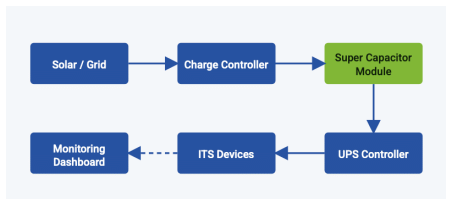
Figure 1: Simplified super capacitor backup and off-grid power architecture for ITS sites (Solar/Grid → Charge Controller → Super Capacitor Module → UPS Controller → ITS Devices, with a Monitoring Dashboard).
The UDOT Evaluation
Academic Research
UDOT worked with a group of BYU engineering students to determine whether super capacitors could replace batteries in signal backup systems. The work was documented in the 2024 BYU capstone report, Battery Backup System for Integrated Traffic Systems.
Requirements and Testing
In 2024, UDOT’s Transportation Technology Group set out to find a backup system that could support ITS devices through outages. The solution needed to provide at least four hours of power while operating reliably from 0°F to 140°F. UDOT also worked with Econolite to adapt the technology to UDOT’s currently deployed ITS systems.
Table 1: Testing requirements and results
| Measure | Value |
|---|---|
| Tested runtime | 9.25 hours |
| Minimum required runtime | 4 hours |
| Required temperature range | 0°F to 140°F |
| Cycle rating (Econolite, up to) | 1,000,000 charge/discharge cycles |
System Integration and Monitoring
The ZX graphene super capacitor modules were integrated with an uninterruptible power supply (UPS) controller to back up ITS devices, including CCTV cameras and remote traffic management system equipment. A monitoring dashboard lets operators remotely view system status and performance, and it integrates with solar-powered installations and the existing charge controllers used at remote sites.
Field Deployment
The first field installation powered an off-grid CCTV camera along SR 143 near Brian Head. Its performance during the final two months of the 2024 winter season prompted broader adoption:
Table 2: UDOT lists the innovation as fully implemented as of May 1, 2024.
| UDOT group | Application | Status |
|---|---|---|
| Region Four | Replacing nearly two dozen battery systems | Over the next few years |
| Region Three | Upgrading nearly half a dozen challenging off-grid sites | Planned |
| Performance and Asset Management | Traffic count sites | Testing |
| Traffic Management Division | Traffic signal backup systems | Ongoing development |
Results and Impact
Super capacitors cost more up front than lead-acid batteries, but UDOT reports that a 15-year-plus lifespan and low maintenance offset the price difference several times over. Econolite cites service life of up to 30 years.
- Better mobility: ITS and signal benefits reach challenging climates and locations
- Good health: Fewer safety and environmental concerns
- Connected communities: Remote areas join the traffic information system
- Strong economy: Virtually zero maintenance costs
Table 3: Benefits are estimated net of initial and ongoing expenses and averaged over the expected benefit life.
| Metric (UDOT estimate) | Value |
|---|---|
| Cost avoidance, May 1, 2024 to May 1, 2039 | $195,508 |
| Labor savings | 53 hours annually |
| Benefit/cost ratio | 3:1 |
Considerations for Agencies
Agencies weighing super capacitors should compare total cost of ownership rather than purchase price, identify the sites where locations and conditions—including extreme weather, altitude, weight, susceptibility to natural hazards, or access—make battery service most expensive, and confirm runtime requirements against the site’s electrical load requirements.
UDOT has also encouraged others to consider what other challenging applications a super capacitor could address.
Conclusion
Reliable power is the foundation of every ITS device. UDOT’s experience shows that super capacitor energy storage can meet demanding temperature and runtime requirements at remote sites while cutting replacement cycles, labor, weight, and environmental risk.
Following its evaluation, UDOT has started to deploy the super capacitor technology solution as part of a replacement program for legacy battery backup systems, including plans to upgrade battery backup systems statewide. Super capacitors extend dependable ITS operation to the locations that traditional lead-acid-based batteries serve least well: remote, high-altitude, and extreme-temperature sites.
Contact Us
We are here to help. Reach out to our team for assistance.
Click the button below to reach a team member for assistance or inquiries.
References
- Utah DOT Innovation Stories. Super Capacitors Power Signal and ITS Devices in Challenging Environments, Item #20240064. https://sites.google.com/utah.gov/udot-i/c/20240064
- BYU Capstone Project Report. Battery Backup System for Integrated Traffic Systems (Final Design Report), 2024. https://drive.google.com/file/d/19lAXxxMoZvMaKcfyhaeoOe3UrgDX_zCw/view
- Econolite. Utah DOT Selects Econolite Super Capacitor for its Battery Backup System Upgrade Project, July 11, 2024. https://www.econolite.com/in-action/case-study/utah-dot-super-capacitor-battery-backup/