Connected Vehicle SPaT Deployment Challenge Case Study
The Connected Vehicle Signal Phase and Timing (SPaT) Challenge project helped accelerate deployment of connected vehicle infrastructure across key corridors in the United States. SPaT messages provide real-time information on signal phases and timing, which supports safer and more efficient traffic operations. Econolite partnered with the Maryland State Highway Authority (MSHA) to implement a complete connected vehicle solution on select arterial roads, ensuring standardized SPaT broadcasting along multiple intersections.
Project Background
The project focused on deploying connected vehicle technology along US Highway 1 and MD 175 in Howard County, Maryland. These corridors include signalized intersections that were selected to meet the SPaT Challenge requirement of broadcasting real-time signal data along approximately 20 intersections. The goal was to improve V2I communications and provide a foundation for future connected and automated vehicle applications.
Connected Vehicle Deployment
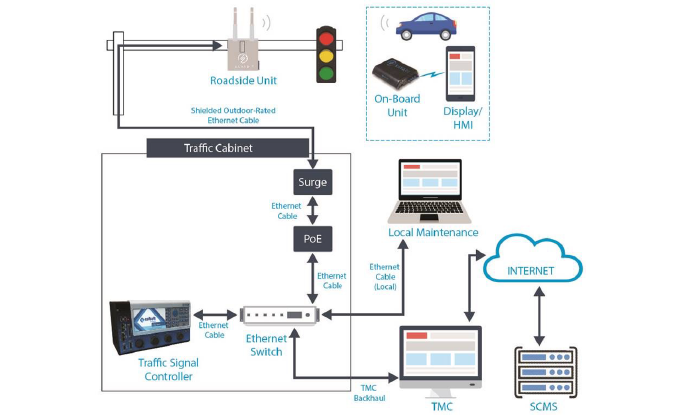
To meet project objectives, Econolite installed and integrated a full connected vehicle infrastructure, including:
- 20 Commsignia dual-mode CV Roadside Units (RSUs)
- 5 Connected Vehicle On-Board Units (OBUs) for testing
- Secure configuration using a Security Credential Management System (SCMS)
- Integration with existing traffic signal systems and communication networks
The deployment ensured that SPaT messages could be broadcast reliably along the corridor, allowing vehicles and road users to receive real-time signal information. Vendor evaluation was conducted to select the optimal dual-mode technology solution for both current needs and future scalability.
Key Features of the Connected Vehicle SPaT Deployment
- Real-time SPaT broadcasting along ~20 intersections
- Enhanced vehicle-to-infrastructure (V2I) communications
- Turnkey deployment including design, installation, and integration
- Secure messaging using SCMS
- Evaluation of multiple vendors for optimal technology selection
Operational Benefits
As a result of this deployment, agencies and transportation operators can now:
- Receive accurate, real-time signal phase and timing information
- Improve safety for vehicles and non-motorized road users
- Enable future connected and automated vehicle applications
- Monitor network performance and reliability
- Plan and expand connected vehicle infrastructure efficiently
Overall, this SPaT deployment strengthened the corridor’s connected vehicle infrastructure and provided a scalable platform for future smart mobility improvements.